From brief to delivery: the 7 stages of a motion design project

What happens in the 30 days between brief and final video
You hand over the brief and disappear. 30 days later, you receive a beautiful finished video.
It seems like magic. It’s not.
It’s process.
The 7 phases
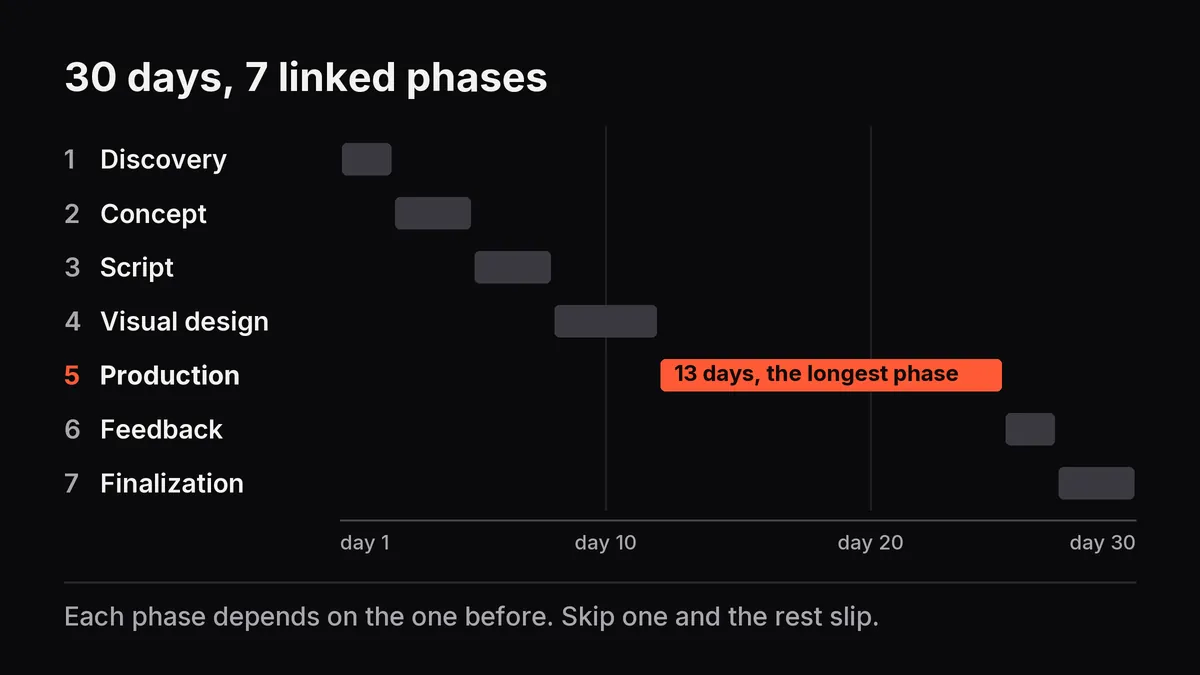
Phase 1: Discovery (days 1-2) Understanding the real objective, audience, competition, budget and timeline.
Phase 2: Concept (days 3-5) Generate ideas, refine them, approve 1 or 2 concepts.
Phase 3: Script (days 6-8) Document the narrative, sequence, emotions and music timing.
Phase 4: Art direction (days 9-12) Define colors, typography, illustration style and the asset list.
Phase 5: Production (days 13-25) That’s 13 days, nearly half the total time: illustration, 3D modeling, animation, effects, composition.
Phase 6: Feedback and revisions (days 26-27) One round of structured feedback. Then done.
Phase 7: Finishing (days 28-30) Color grading, audio mastering, export, testing.
Why 30 days?
Each phase depends on the previous one. You can’t animate without a concept, and you can’t finish without feedback.
Skipping steps costs quality.

How to accelerate (without compromising)
- Clear, quick brief (save 3 days)
- Fast approvals (save 2 days)
- Structured feedback (save 3 days)
- No concept changes mid-project (save 5+ days)
Now you know why quality takes time. The flow is similar for visual identity and interfaces: see how I work. Have a project to start? Get a quote and we’ll begin with phase 1.